
You finally decided to paint that dingy ceiling. Twenty minutes later, you’re standing in a war zone—paint splattered across your floors, furniture spotted with white dots, and somehow there’s a streak of Eggshell White running down your forehead. Sound familiar? Most interior house painters will tell you that ceiling work separates the amateurs from the pros. But here’s the thing: learning how to paint a ceiling without making a mess doesn’t require years of experience or expensive equipment. It requires the right technique, proper preparation, and a few insider tricks that professional painters use every single day.
The average homeowner spends 2-3 hours cleaning up paint drips and splatters after a ceiling project. That’s time you’ll never get back. Worse, some of those drips can cause permanent damage to hardwood floors or upholstered furniture. The good news? With the approach outlined below, you can reduce cleanup time to near zero and actually enjoy the painting process.
Key Takeaways:

Why Ceiling Painting Gets So Messy in the First Place
Gravity is not your friend when painting overhead. Every drop of paint on your roller wants to fall—onto your arm, your face, your floors, and everything else beneath it. When you combine gravity with an overloaded roller, fast movements, or improper technique, you’ve got a recipe for disaster.
Most homeowners make the same mistakes: they load too much paint onto the roller, move too quickly, and skip the preparation steps that would have protected their space. The result? A ceiling that might look okay (eventually), surrounded by a room that looks like a paint bomb exploded.
Professional painters approach ceiling work differently. They understand that the setup is just as important as the actual painting. They know which tools minimize dripping and which techniques keep paint where it belongs—on the ceiling, not on everything else.
Gathering Your Tools: How to Paint a Ceiling Without Making a Mess Starts Here
The tools you choose will make or break your project. Cheap rollers shed fibers onto your ceiling. The wrong nap thickness either starves the surface of paint or dumps too much at once. Here’s what actually works:
- Quality roller frame with a sturdy cage: Skip the flimsy frames from the dollar store. A solid frame keeps your roller cover secure and spinning smoothly, which means more control and fewer drips.
- 3/8″ to 1/2″ nap roller covers: For smooth or lightly textured ceilings, this thickness holds enough paint for good coverage without becoming overloaded. Textured ceilings may need 3/4″ nap.
- Extension pole (4-8 feet adjustable): This keeps you off the ladder for most of the work. Less climbing means fewer opportunities to knock into things or drip paint while repositioning.
- 5-gallon bucket with paint grid: Forget the roller tray. A bucket holds more paint, tips over less easily, and the grid gives you better control over how much paint stays on your roller.
- 2″ to 2.5″ angled brush: For cutting in around edges, light fixtures, and corners. A quality brush with tapered bristles gives you precision without dripping.
- Painter’s tape and drop cloths: Canvas drop cloths absorb drips better than plastic. Tape protects crown molding and walls from accidental brush strokes.
Room Preparation: The Step Most People Skip
Here’s an uncomfortable truth: if you spend 30 minutes preparing your room properly, you’ll spend maybe 5 minutes on cleanup. Skip the preparation, and you’ll spend hours scrubbing paint off surfaces where it doesn’t belong. The math is simple.
Start by removing everything you can from the room. Furniture, lamps, wall décor—all of it. Yes, it’s a hassle. But paint spatters travel farther than you’d expect, and nothing ruins a day faster than realizing your grandmother’s antique chair now has a permanent polka-dot pattern.
For furniture that can’t be moved, push everything to the center of the room and cover it completely with drop cloths. Don’t just drape them—tuck them in and tape down the edges. A loose drop cloth will shift while you’re working, exposing whatever you were trying to protect.
Cover your floors completely. Canvas drop cloths work better than plastic because they stay in place and absorb paint rather than letting it pool and spread. If you’re using plastic, tape down every edge. Stepping on a loose plastic sheet and skating across the room is both dangerous and messy.
Don’t forget to protect your light fixtures. Either remove them entirely or wrap them carefully with plastic sheeting and tape. Ceiling fans should be removed if possible—those blades will send any paint drip flying across the room.
The Proper Rolling Technique for Drip-Free Ceilings
This is where most DIY painters go wrong. They dip the roller, see that it’s covered in paint, and immediately start rolling as fast as possible. The result is predictable: splatters everywhere.
Load your roller correctly. Dip it into the paint, then roll it up and down the grid 4-5 times. You want the roller evenly coated but not dripping. If paint is running off the roller when you lift it, you’ve got too much. Roll off the excess on the grid until it stops dripping.
Use the “W” pattern. Start by rolling a large W shape on the ceiling (about 3-4 feet wide), then fill in the area with straight, overlapping strokes. This distributes the paint evenly and prevents heavy buildup in any one spot. Heavy buildup equals drips.
Maintain consistent, moderate pressure. Pressing too hard squeezes paint out of the roller and onto your face. Too light, and you won’t get good coverage. Find a comfortable middle ground and stay there.
Slow down. Fast rolling creates centrifugal force that flings paint droplets in every direction. A slow, deliberate pace keeps the paint on the roller and ceiling where it belongs. Professional painters might look like they’re moving slowly, but they’re actually being efficient—they don’t have to stop and clean up messes.
Keep a wet edge. Work in sections small enough that you can blend into the previous section before it dries. Trying to blend into dried paint creates lap marks and often requires pressing harder, which leads to more drips.
Cutting In: Handling Edges and Corners Cleanly
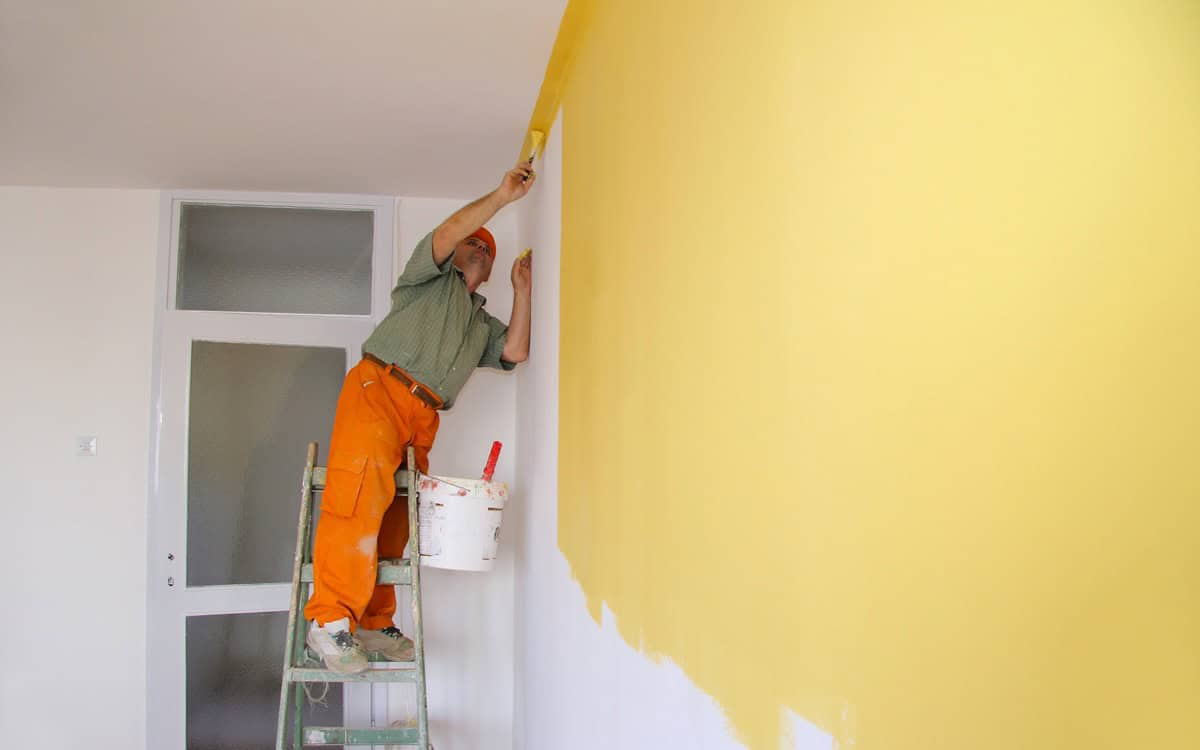
The edges where your ceiling meets the walls are where most dripping disasters happen. Rollers can’t reach into corners precisely, so you need a brush—and brush work near edges tends to drip down walls.
Cut in a 2-3 inch border around the entire ceiling before you start rolling. Use your angled brush, load it with paint (not too much—wipe off the excess on the rim of your can), and apply steady, even strokes along the edge.
The key is to paint with the tip of the brush, not the whole thing pressed flat against the surface. This gives you control and prevents paint from squishing out the sides of the bristles onto your walls.
If you’re worried about keeping a straight line where ceiling meets wall, apply painter’s tape to the wall about 1/8″ below the ceiling line. This creates a small gap that helps you see exactly where to stop and provides a barrier if your brush slips.
Common Mistakes That Turn Ceiling Painting Into a Mess
Even with the right tools and technique, a few common mistakes can undo all your careful work:
- Overloading the roller: If your roller is dripping when you lift it from the paint, you’re already in trouble. More paint on the roller doesn’t mean faster coverage—it means more drips.
- Rolling too fast: Speed creates spatters. Every time. Slow, controlled movements win.
- Ignoring drips as they happen: When you see a drip forming, stop and deal with it immediately. Wet paint is easy to wipe away; dried paint requires scraping.
- Using worn-out equipment: Old roller covers shed fibers and don’t hold paint evenly. Old brushes lose their shape and drip unpredictably. Fresh tools cost a few dollars and save hours of frustration.
- Skipping the second coat: Trying to get full coverage in one thick coat leads to dripping, sagging, and uneven color. Two thin coats always look better and cause fewer problems than one thick coat.
When DIY Ceiling Painting Might Not Be Worth It
Some ceilings are genuinely difficult for homeowners to paint well. Very high ceilings (over 10-12 feet), heavily textured surfaces like popcorn ceilings, or ceilings with significant water damage or repairs may require specialized equipment or techniques that go beyond what most DIYers have available.
There’s also the time factor to consider. A professional painting crew can knock out a ceiling in a fraction of the time it takes a homeowner—and they bring their own equipment, handle their own cleanup, and guarantee their work.
If your ceiling project is straightforward—smooth or lightly textured surface, accessible height, no major repairs needed—the techniques in this guide will serve you well. But if you’re looking at a complex project, or if your time is worth more than the cost of hiring help, calling a professional makes sense.
Ready to Get Started—Or Ready for Help?
Painting your ceiling without turning your room into a Jackson Pollock exhibit is absolutely doable. With the right preparation, proper tools, and patient technique, you can get professional-looking results and walk away from the project without paint in your hair.
But if you’d rather skip the ladder work entirely—or if your ceiling situation is more complicated than a simple refresh—Procoat Painting San Diego Residential Commercial Painters is here to help. Our experienced crews handle ceiling projects of all sizes, from single rooms to entire homes, and we leave your space cleaner than we found it.
Give us a call at 619-353-5394 to schedule a free estimate. We’ll take a look at your ceiling, discuss your options, and give you an honest assessment of what the project will involve. No pressure, no obligation—just straightforward advice from painters who’ve done this work thousands of times.
Whether you tackle it yourself or let us handle the hard part, your ceiling deserves to look its best. Let’s make it happen.